

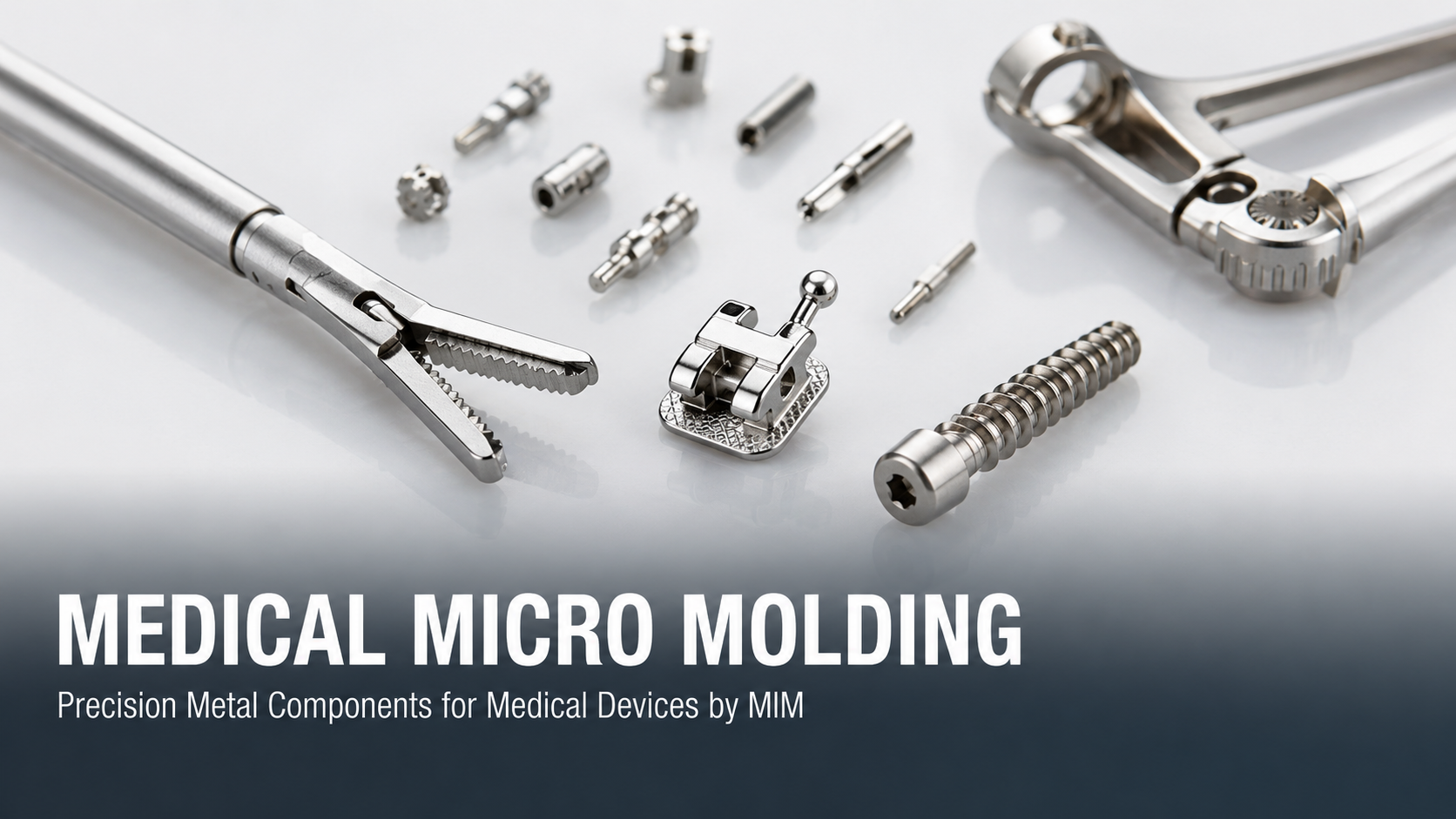
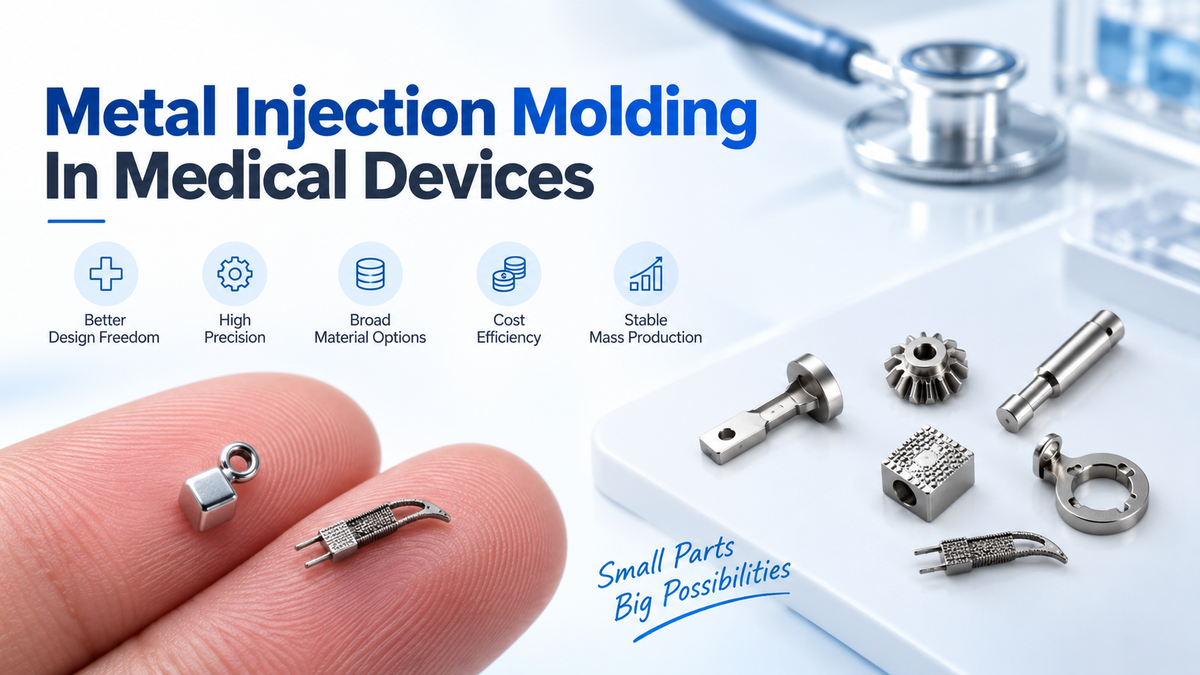
La miniaturización de los dispositivos médicos —impulsada por la cirugía mínimamente invasiva, los diagnósticos portátiles y la administración de fármacos de próxima generación— exige cada vez más de los procesos de fabricación utilizados para producir componentes metálicos de precisión. Las piezas que antes podían mecanizarse individualmente en bajo volumen ahora deben producirse en decenas o cientos de miles anualmente, con dimensiones que se miden en fracciones de milímetro, a partir de aleaciones biocompatibles y con tolerancias estrictas.
El moldeo por inyección de metales (MIM) se ha convertido en el proceso de producción estándar para esta categoría de componentes. El término micro moldeo médico se utiliza ampliamente en la industria; en muchos contextos se refiere al micro moldeo por inyección de plástico para puntas de catéteres, conectores y carcasas. Este artículo se centra específicamente en el micro moldeo médico de metal mediante MIM: la producción de componentes metálicos complejos y en miniatura para dispositivos médicos donde el plástico no es una opción y el mecanizado no es económicamente viable en volumen de producción.

¿Qué es el micro moldeo médico en el contexto del MIM?
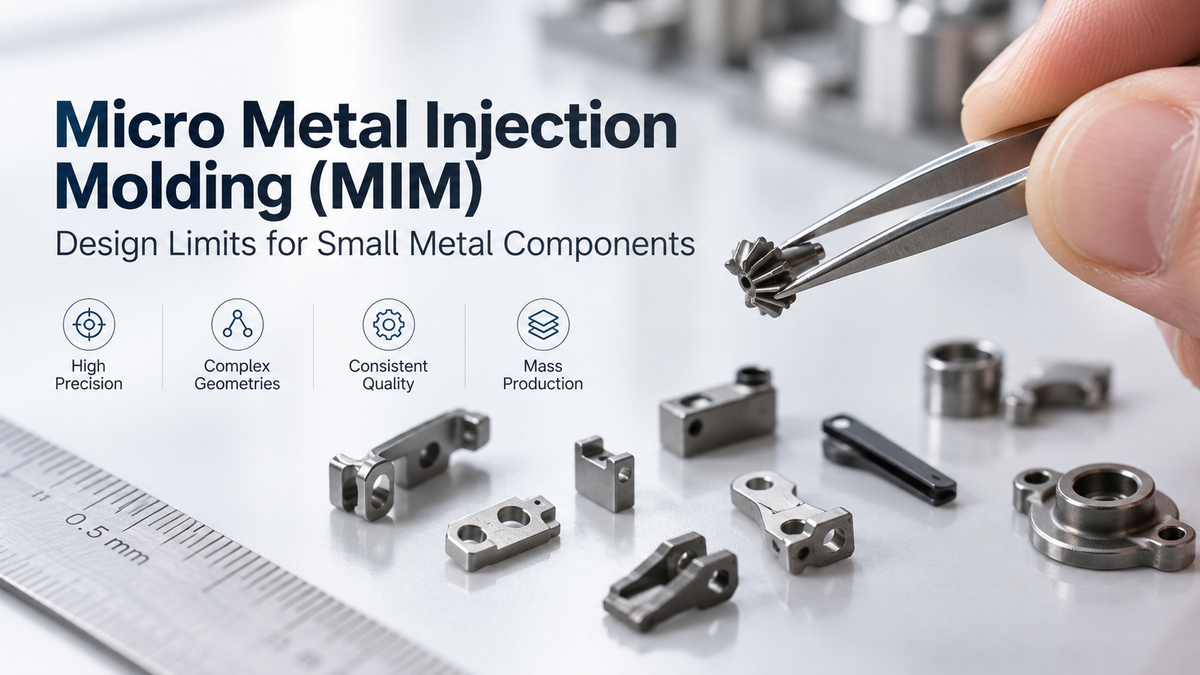
En MIM, "micro" se refiere típicamente a piezas con dimensiones generales inferiores a 20-25 mm, características individuales inferiores a 1 mm, pesos de pieza inferiores a 1 g y espesores de pared de hasta 0.3-0.5 mm. Estos no son límites absolutos —algunos componentes MIM médicos son más grandes— pero esta escala representa donde las ventajas del MIM sobre otros procesos alternativos de fabricación de metales son más pronunciadas.
A microescala, la economía y las capacidades de las rutas de fabricación convencionales cambian drásticamente. El mecanizado CNC de un componente de acero inoxidable de 0.8 g con cavidades internas, orificios pasantes y características roscadas puede requerir de 8 a 15 minutos de tiempo de máquina por pieza y generar entre un 80% y un 90% de residuos de material. Con 50,000 piezas al año, el costo de mecanizado por pieza es prohibitivo. El MIM produce la misma geometría en un tiempo de ciclo que se mide en segundos, a partir de una materia prima con casi cero residuos de material, a una fracción del costo por pieza.
Por qué se utiliza el MIM para microcomponentes médicos
Capacidad de geometría a microescala
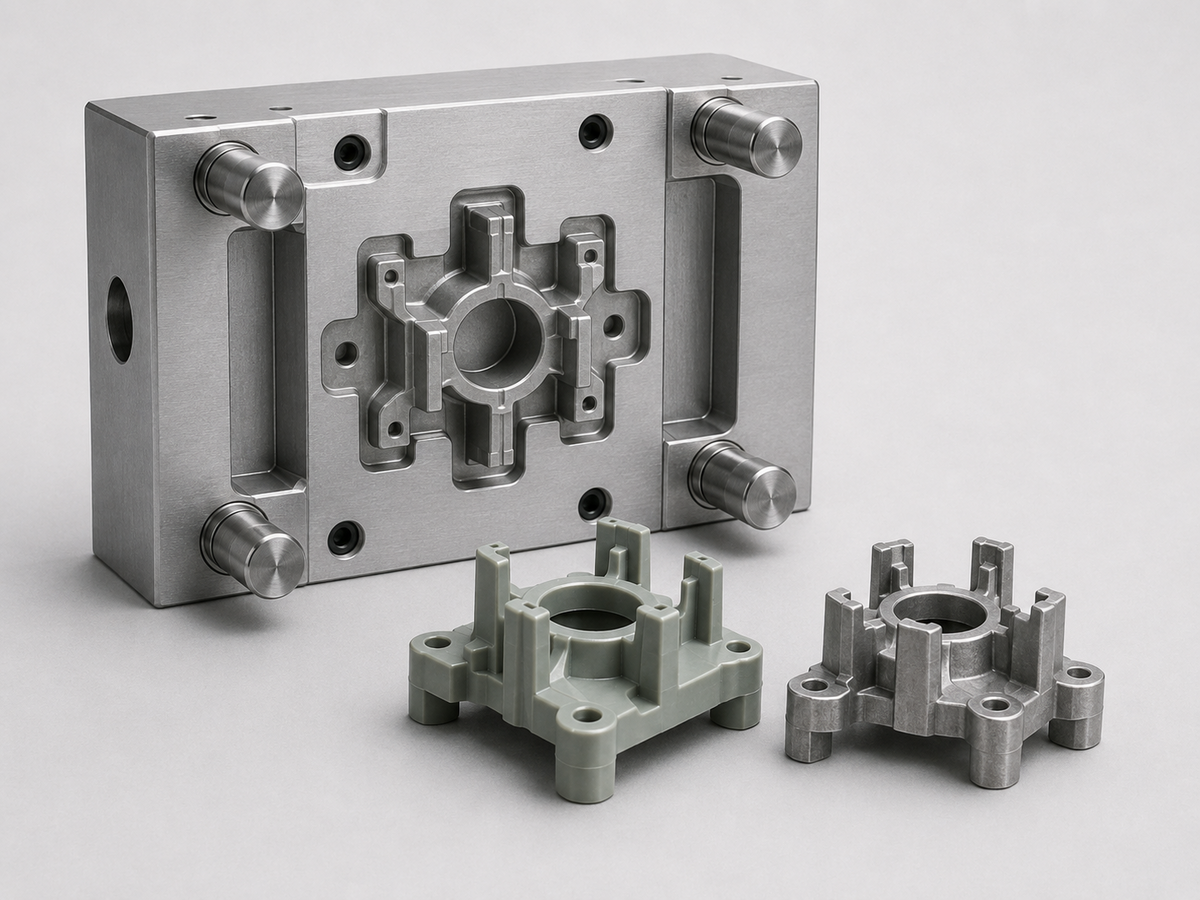
Las características que definen los microcomponentes médicos de precisión —mecanismos de mandíbula, geometrías de clips, elementos de bloqueo, pivotes de articulación, roscas finas y paredes delgadas— se forman en el molde MIM. Esta geometría emerge de la etapa de moldeo por inyección: las socavaduras, los orificios pasantes, las cavidades internas y los perfiles curvos complejos se pueden lograr mediante el diseño del molde, no mediante el mecanizado secundario.
A microescala, esto importa más que en cualquier otro rango de tamaño. Una punta de mandíbula laparoscópica de 15 mm con cuatro características internas y un orificio de pivote de 0.5 mm requeriría un mínimo de tres configuraciones de mecanizado y múltiples herramientas de corte especializadas. El equivalente de MIM se produce como una sola pieza de forma casi neta, con todas las características internas y externas formadas simultáneamente. Las operaciones secundarias se limitan a las superficies de acoplamiento críticas, una fracción del costo total del mecanizado.
Materiales biocompatibles en volumen de producción
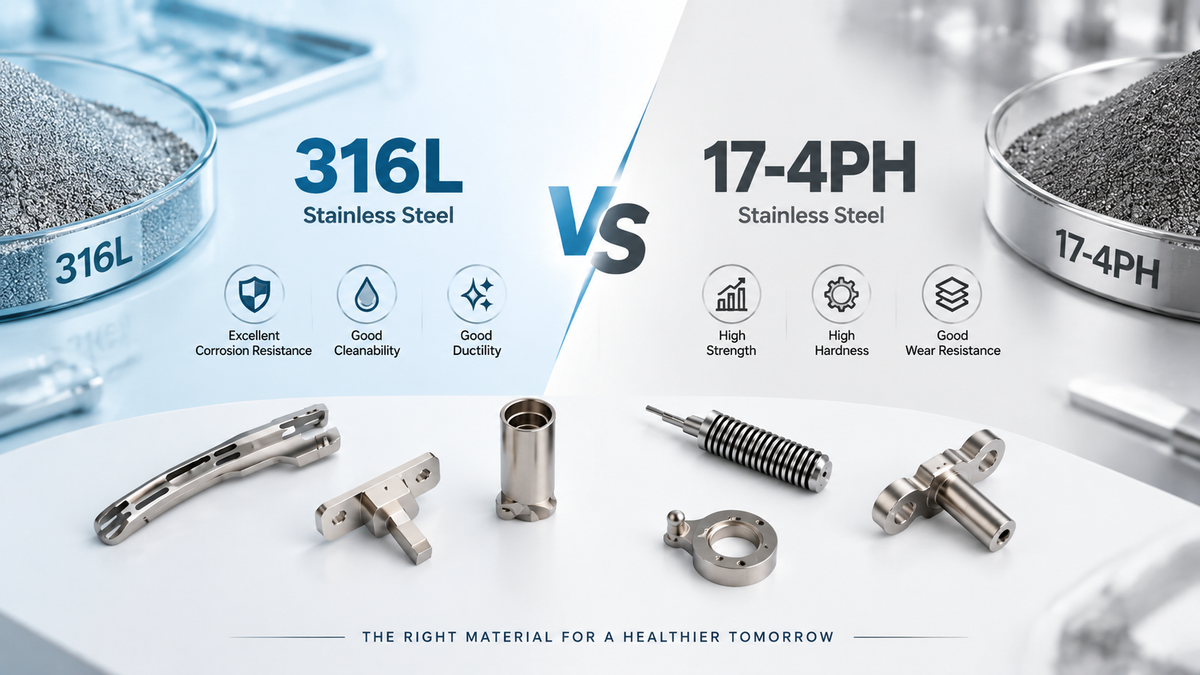
Las piezas médicas MIM se producen a partir de aleaciones con datos de biocompatibilidad establecidos: acero inoxidable 316L para instrumentos generales y aplicaciones adyacentes a implantes, 17-4PH para componentes estructurales de mayor resistencia y Ti-6Al-4V para aplicaciones implantables y compatibles con resonancia magnética. Las tres se procesan rutinariamente mediante MIM en volúmenes de producción, con densidades sinterizadas del 96-99% que ofrecen propiedades mecánicas que se aproximan a las de los equivalentes forjados.
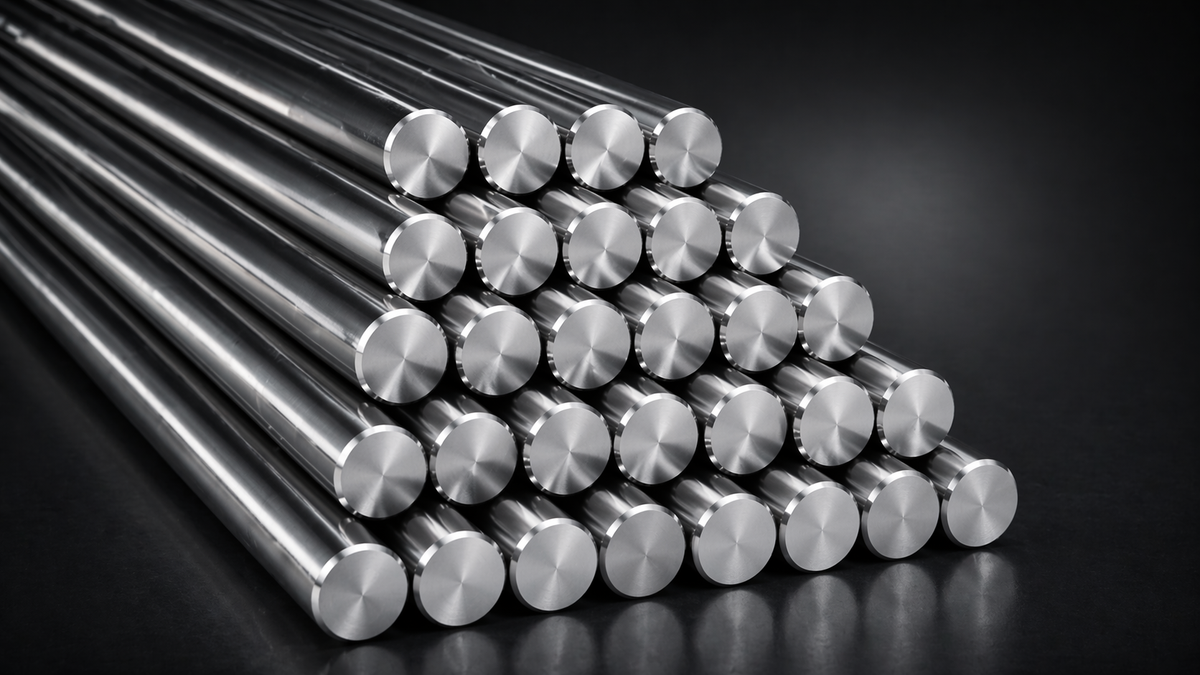
Las mismas aleaciones mecanizadas individualmente a partir de barras a microescala presentan una tasa de desperdicio de material del 80-95%, la mayor parte del material de entrada se corta. El MIM utiliza materia prima en polvo que se consume casi por completo en la pieza terminada, lo que es significativa tanto económica como prácticamente cuando se trabaja con aleaciones de grado médico premium como el Ti-6Al-4V.
Volumen y consistencia de la producción
Los volúmenes de producción de dispositivos médicos para componentes de instrumentos quirúrgicos suelen oscilar entre 10,000 y 500,000 piezas al año. El ciclo de moldeo por inyección del MIM —normalmente de 15 a 45 segundos— significa que los utillajes de varias cavidades pueden producir 4, 8 o 16 piezas por ciclo, lo que permite volúmenes anuales elevados con costes unitarios estables. Una vez cualificado el molde y el proceso, la consistencia pieza a pieza se mantiene por la propia geometría del molde, en lugar de por la habilidad del operario, lo cual es fundamental para la fabricación regulada de dispositivos médicos.

Aplicaciones clave del micro moldeo médico mediante MIM
Instrumentos quirúrgicos mínimamente invasivos
Los instrumentos MIS —pinzas laparoscópicas, aplicadores de clips, fórceps de biopsia y portaagujas— requieren mecanismos de mandíbula en miniatura, enlaces de articulación y componentes pivotantes funcionales que combinen una geometría precisa con la resistencia y la resistencia a la corrosión del acero inoxidable de grado quirúrgico. Estos componentes suelen tener una longitud de 10 a 30 mm, un peso inferior a un gramo y requieren características —orificios de pivote, perfiles de mandíbula, muescas de bloqueo— que son prohibitivamente costosas de mecanizar individualmente. El MIM los produce en los volúmenes necesarios para la fabricación comercial de instrumentos quirúrgicos.
Los accesorios endoscópicos, incluidos los componentes de las copas de los fórceps de biopsia, los componentes de las cestas de recuperación de cuerpos extraños y las piezas de los cartuchos de los clips hemostáticos, siguen el mismo perfil: pequeños, complejos, de acero inoxidable y de alto volumen.
Componentes ortopédicos y espinales
Los componentes de tornillos óseos, el hardware de fijación espinal y las pequeñas piezas de fijación ortopédica utilizan el MIM por las mismas razones: formas de rosca complejas, huecos de accionamiento, elementos de bloqueo socavados y pequeñas dimensiones que, combinadas, encarecen el mecanizado. Las piezas de MIM de 17-4PH y Ti-6Al-4V ofrecen la relación resistencia-peso necesaria para aplicaciones ortopédicas de carga con la economía de volumen que requieren las empresas de dispositivos médicos.
Componentes dentales
Los brackets de ortodoncia, una de las aplicaciones médicas de MIM más antiguas a nivel mundial, se producen casi exclusivamente mediante MIM. La geometría del bracket incluye una ranura de precisión para el enganche del arco, aletas de ligadura y una base de unión con características de malla o almohadilla de retención, todo en una pieza que pesa aproximadamente 0.08–0.15 g. El mecanizado manual de los brackets de ortodoncia no es comercialmente viable. El MIM produce millones de brackets anualmente de acero inoxidable 316L con tolerancias de ancho de ranura consistentes de ±0.02 mm.
Los subcomponentes de los pilares de implantes dentales, los insertos de los mangos de los instrumentos y los componentes de las piezas de mano también se producen mediante MIM tanto en acero inoxidable como en titanio.
Dispositivos de administración de fármacos
Los componentes del actuador de válvulas, los cuerpos de las válvulas dosificadoras y los elementos mecánicos funcionales de los autoinyectores e inhaladores utilizan cada vez más piezas de acero inoxidable MIM cuando el plástico no puede satisfacer los requisitos de carga mecánica, estabilidad dimensional o ciclos de esterilización. La geometría de precisión de los mecanismos de las válvulas de administración de fármacos —asientos de muelles, vástagos de accionamiento, cámaras dosificadoras— se adapta bien a la capacidad de forma casi neta del MIM.
Selección de materiales para microcomponentes médicos MIM
El acero inoxidable 316L es el material más utilizado para los componentes MIM médicos. Es biocompatible según la norma ISO 10993, resistente a la corrosión en fluidos corporales y entornos de esterilización, y electropulible para obtener un acabado superficial liso y fácil de limpiar. El MIM 316L alcanza una resistencia a la tracción de 480-520 MPa en estado sinterizado, aumentando a 600-700 MPa con el trabajo en frío. Es el material estándar para instrumentos quirúrgicos, brackets de ortodoncia, componentes endoscópicos y carcasas de instrumentos.
El acero inoxidable 17-4PH proporciona una mayor resistencia que el 316L —Resistencia a la tracción de 900-1,100 MPa después del tratamiento térmico H900— para componentes estructurales sujetos a mayores cargas mecánicas. Se utiliza para piezas de fijación ortopédica, elementos estructurales de instrumentos quirúrgicos y componentes donde la resistencia del 316L es insuficiente. El 17-4PH es biocompatible y resistente a la corrosión, aunque contiene una pequeña cantidad de cobre que puede requerir una revisión de biocompatibilidad específica para aplicaciones implantables.
El Ti-6Al-4V es el material preferido para componentes implantables y aplicaciones que requieren compatibilidad con resonancia magnética. Tiene la mayor relación resistencia-peso entre los materiales MIM médicos, es totalmente biocompatible según ISO 10993 y ASTM F136, y es radiotransparente en aplicaciones de imagen. El Ti-6Al-4V MIM es más exigente de procesar que el acero inoxidable —requiriendo sinterización al vacío y un cuidadoso control de la atmósfera— y tiene un costo unitario más alto, pero es la elección correcta cuando se requiere implantabilidad o compatibilidad con resonancia magnética.

Consideraciones de diseño para piezas micro MIM médicas
Tamaño mínimo de características: El MIM puede producir de forma fiable características de hasta aproximadamente 0.3 mm a microescala. Por debajo de este umbral, la consistencia del llenado de las características disminuye y la repetibilidad dimensional se reduce. Para características inferiores a 0.5 mm, consulte con el equipo de fabricación durante la revisión de DFM.
Espesor de pared: Espesor mínimo de pared 0.3–0.5 mm para micro piezas. Las paredes más delgadas aumentan la fragilidad durante la manipulación de piezas en verde y marrón. El espesor de pared uniforme minimiza la contracción diferencial de la sinterización y mejora la rectitud de la pieza.
Radios de esquina: Las esquinas internas deben tener un radio mínimo de 0.1-0.2 mm para reducir la concentración de tensiones. A microescala, las esquinas internas afiladas también provocan desgaste del molde y problemas de llenado durante la inyección.
Tolerancias: Las tolerancias dimensionales en estado sinterizado para piezas micro MIM médicas son típicamente ±0.3–0.5% de la dimensión nominal. Para características críticas —diámetros de orificios de pivote, anchos de ranuras de mandíbula, superficies de acoplamiento— el rectificado secundario, el EDM o el lapeado alcanzan tolerancias de ±0.01–0.02 mm. Especifique operaciones secundarias solo en superficies verdaderamente funcionales para controlar los costos.
Acabado de superficie: El Ra de 0.8–1.6 µm en estado sinterizado es el estándar. El electropulido reduce el Ra a 0.2–0.4 µm y mejora simultáneamente la resistencia a la corrosión al disolver la capa superficial y pasivar la superficie de acero inoxidable; es una práctica estándar para los componentes de instrumentos médicos y muy recomendable para las superficies en contacto con fluidos o adyacentes a implantes.
Calidad y cumplimiento normativo
La producción de MIM médico para fabricantes de dispositivos requiere una gestión de calidad según ISO 13485, el estándar de gestión de calidad específico para las cadenas de suministro de dispositivos médicos. La certificación ISO 13485 cubre el proceso de producción completo, desde la cualificación de la materia prima hasta la inspección final y la documentación de trazabilidad.
La biocompatibilidad del material MIM se confirma según las normas ISO 10993 mediante la verificación de la composición química y, para aplicaciones implantables, pruebas de biocompatibilidad formales. La densidad sinterizada se verifica mediante el método de Arquímedes para confirmar que la pieza cumple la especificación de densidad requerida para las propiedades mecánicas del material.
La inspección dimensional para piezas médicas micro MIM utiliza mediciones CMM o sistemas de medición óptica capaces de resolver características a un nivel de 0.01 mm. La documentación de la inspección del primer artículo (FAI) se proporciona antes de la liberación de la producción, cubriendo todas las dimensiones del dibujo, la certificación del material, la verificación de la densidad y la medición del acabado superficial.
Para los componentes de dispositivos implantables, se mantiene la trazabilidad del material desde el lote de polvo crudo hasta la pieza terminada en todo el registro de producción.
Caso de aplicación: Punta de mandíbula MIM para pinza laparoscópica de un solo uso
Un cliente de dispositivos médicos que desarrollaba una pinza laparoscópica de 5 mm de un solo uso requería componentes de punta de mandíbula de acero inoxidable 316L. La geometría de la mandíbula incluía una cara de agarre perfilada, un orificio de pivote de 0.8 mm, dos muescas de bloqueo opuestas y una ranura de retención de resorte, siete características geométricas distintas en un espacio de 12 mm × 3 mm × 2.5 mm, con un peso final de 0.4 g.
Las primeras piezas prototipo se mecanizaron por CNC a partir de una barra de 316L. El costo de mecanizado al volumen de producción previsto de 80,000 pares al año se evaluó y se encontró comercialmente inviable: el tiempo de ciclo por mandíbula excedía los 12 minutos con un proceso de 4 configuraciones, produciendo un costo unitario incompatible con el precio de los dispositivos de un solo uso.
Se revisó la geometría para evaluar la viabilidad del MIM. Las siete características eran conformables en estado sinterizado: el orificio del pivote se formaba mediante un pasador central en el molde; las muescas de bloqueo y la ranura del resorte se formaban mediante correderas. Las operaciones secundarias se limitaron al escariado del orificio del pivote al diámetro final (±0.015 mm) y al electropulido para el acabado superficial y el rendimiento de la corrosión.
Con un volumen anual de 80,000 pares, el costo unitario del MIM, incluyendo el escariado secundario y el electropulido, fue un 78% menor que el costo de la pieza mecanizada. El FAI se completó en 6 semanas desde la entrega del molde. El programa pasó a la cualificación de la producción bajo el plan de calidad ISO 13485 del cliente.

Qué proporcionar para una cotización de Micro MIM médico
- Dibujo de ingeniería 2D con todas las dimensiones, tolerancias y requisitos de acabado superficial, incluyendo las anotaciones de GD&T en las características funcionales.
- Modelo 3D en formato STEP, STP, X_T o IGES.
- Especificación del material: 316L, 17-4PH, Ti-6Al-4V u otro.
- Biocompatibilidad y estado regulatorio: probado según ISO 10993, implantable, de grado instrumental o de un solo uso.
- Volumen anual y cantidad de prototipos/muestras.
- Requisitos de acabado post-sinterizado: electropulido, pasivación, rectificado, lapeado, recubrimiento.
- Requisitos de documentación de calidad: ISO 13485, FAI, trazabilidad de materiales, certificado de conformidad.
Preguntas Frecuentes
¿Qué es el micro moldeo médico?
En el contexto de los componentes metálicos, el micro moldeo médico se refiere a la producción de piezas metálicas de precisión en miniatura para dispositivos médicos utilizando el moldeo por inyección de metales. Se aplica a componentes con dimensiones típicamente inferiores a 25 mm, tamaños de características inferiores a 1 mm y pesos de pieza inferiores a 1 g, producidos a partir de aleaciones biocompatibles como acero inoxidable 316L, 17-4PH o Ti-6Al-4V para su uso en instrumentos quirúrgicos, dispositivos ortopédicos, aplicaciones dentales y sistemas de administración de fármacos.
¿Qué materiales se utilizan para los microcomponentes MIM médicos?
El acero inoxidable 316L es el material más utilizado para instrumentos quirúrgicos y componentes dentales MIM debido a su biocompatibilidad, resistencia a la corrosión y capacidad de electropulido. El 17-4PH proporciona mayor resistencia para componentes estructurales ortopédicos e instrumentales. El Ti-6Al-4V se utiliza para aplicaciones implantables y compatibles con MRI que requieren la mayor biocompatibilidad y relación resistencia-peso. Los tres materiales se procesan rutinariamente mediante MIM en volúmenes de producción.
¿Qué tolerancias se pueden lograr para microcomponentes MIM médicos?
Las tolerancias en estado sinterizado son de ±0.3–0.5% de la dimensión nominal. Las operaciones secundarias logran tolerancias más estrictas en características críticas: el rectificado y el escariado producen ±0.01–0.02 mm en diámetros de orificios y superficies de acoplamiento; el lapeado logra una rugosidad superficial inferior a Ra 0.2 µm en caras de contacto funcionales. El electropulido es estándar para el rendimiento de la corrosión y la limpieza superficial en componentes de instrumentos médicos.
¿El MIM para dispositivos médicos requiere certificación ISO 13485?
La certificación ISO 13485 es el estándar de gestión de calidad relevante para los proveedores de componentes de dispositivos médicos. Cubre los requisitos de control de procesos, trazabilidad, documentación e inspección específicos de la cadena de suministro de dispositivos médicos. Confirme los requisitos del sistema de calidad con su equipo de calidad al principio del proceso de selección de proveedores, ya que los requisitos de documentación y trazabilidad para los componentes médicos añaden tiempo de entrega y costo al proceso de cotización.
¿Cómo se compara el MIM con el mecanizado CNC para microcomponentes médicos?
Para geometrías complejas a microescala en volúmenes de producción superiores a aproximadamente 5,000–10,000 piezas al año, el MIM es significativamente más rentable que el mecanizado CNC. Los tiempos de ciclo de mecanizado para piezas pequeñas y complejas son de 5 a 15+ minutos por pieza con múltiples configuraciones; los tiempos de ciclo de MIM son de 15 a 45 segundos en herramientas de múltiples cavidades. El MIM también elimina el 80–95% de los residuos de material típicos en el mecanizado a partir de barras. Para volúmenes muy bajos, prototipos o piezas geométricamente simples, el mecanizado sigue siendo más rápido de configurar y más flexible para los cambios de diseño.
Conclusión
El micro moldeo médico mediante MIM aborda el desafío fundamental de producir componentes médicos metálicos complejos y en miniatura con los volúmenes y costes unitarios que requiere la fabricación comercial de dispositivos médicos. Donde el mecanizado CNC alcanza sus límites económicos a microescala, el MIM sigue ofreciendo una geometría casi acabada, propiedades del material casi forjadas y la infraestructura de documentación de calidad que exigen las cadenas de suministro de dispositivos médicos regulados. Póngase en contacto con nosotros con sus requisitos de dibujo y aplicación para una revisión de DFM y una cotización.
Compartir:
Moldeo por inyección de cobre para piezas MIM de cobre personalizadas
Piezas de metal sinterizado: propiedades, procesos de fabricación y aplicaciones